

Rising Demand for Caregiving and Emotional Support to Drive Humanoid Companion Robot Market to US$1.1 Billion by 2030, Says TrendForce
TAIPEI, Taiwan, July 16, 2026 (GLOBE NEWSWIRE) -- TrendForce’s latest research on the robotics industry reveals that companion robots have evolved well beyond their original role in elderly care and therapeutic applications pioneered by Japan.
In recent years, the market has expanded toward highly human-like interaction and emotional companionship. Chinese robotics company UBTech Robotics recently unveiled its U1 model—an ultra-biomimetic humanoid robot—marking the beginning of a new era of lifelike companion robots.
As global demographics continue to shift toward aging populations, declining birth rates, and a growing number of single-person households, demand for humanoid companion robots is being fueled by a rapidly emerging "companionship economy." TrendForce estimates the market will reach US$1.1 billion by 2030.
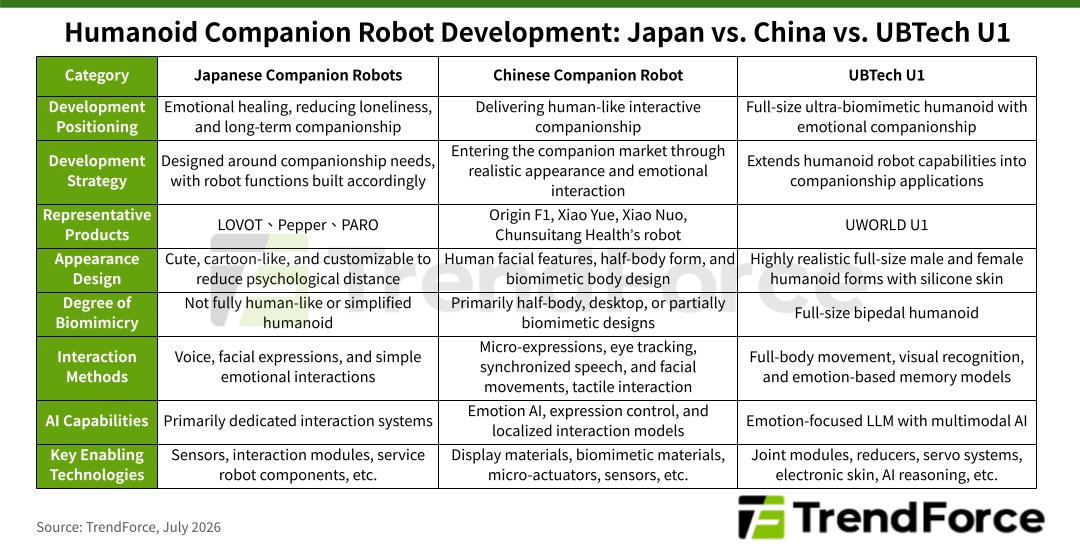
TrendForce notes that Japan was among the earliest markets to develop companion robots. For instance, GROOVE X introduced LOVOT, a robot centered entirely on emotional interaction and therapeutic companionship that deliberately forgoes productivity-oriented functions. Meanwhile, Japan’s National Institute of Advanced Industrial Science and Technology (AIST) and its partners developed PARO, a seal-shaped therapeutic robot widely adopted by long-term care facilities for dementia care and psychological support.
These products have demonstrated the commercial viability of companion robots. They also illustrate Japan's distinctive approach to companion robot design, which prioritizes cute, cartoon-like appearances to enhance user acceptance over highly realistic human forms.
Japanese designs prioritize affinity, while Chinese developers pursue human-like interaction
Compared with Japan’s emphasis on comfort and approachability, Chinese companion robots have increasingly focused on biomimetic appearances, emotional expression, and natural interactions to create a more lifelike user experience. Most manufacturers continue to prioritize companionship while introducing partially humanoid form factors.
For example, Noetix Robotics offers the desktop companion robot Xiao Yue, which features synchronized voice and facial expressions for companionship at home. Chunshuitang Health, meanwhile, focuses on highly realistic human appearances, tactile feedback, and simulated body temperature to create a more immersive companionship experience.
UBTech’s U1 takes this concept a step further. The model boasts highly realistic silicone skin, 88 degrees of freedom, and an emotion-focused LLM that can recognize multiple emotional states. The robot targets consumer applications, including family interaction and psychological support. Unlike many competitors that entered the companion robot market first and later added humanoid features, UBTech has long specialized in humanoid robotics and is now extending its products with the ability to interact emotionally.
This strategy has been enabled by the rapid advancement of China’s supply chain, AI models, and manufacturing capabilities, allowing sophisticated humanoid hardware to be combined with emotional companionship and creating new business opportunities.
TrendForce believes the launch of the U1 demonstrates that the humanoid robot supply chain is expanding beyond industrial applications into the consumer electronics market. In addition to traditional key components such as servo motors, reducers, and joint modules, the importance of high-fidelity synthetic materials, multimodal sensors, micro-expression actuators, emotion AI models, and on-device AI inference is expected to increase significantly, generating new opportunities across the robotics supply chain.
Despite strong market potential, humanoid companion robots still face several challenges. Key hurdles include battery life, the naturalness of emotional interactions, long-term personality and memory consistency, functional safety and privacy protection, and achieving the right balance between product capabilities and pricing.
Manufacturers are expected to place greater emphasis on integrating hardware, AI models, ecosystems, and content services, given that companion robots interact with users far more frequently than industrial robots. While the tens of thousands of orders reportedly received for UBTech’s U1 demonstrate encouraging initial market interest, it remains to be seen whether demand can be sustained beyond early adopters.
For more information on robot reports and market data from TrendForce, please visit the Report Page, or Email (SR_MI@trendforce.com) the Sales Department for a free sample of the 2026 market outlook.
For more on the latest technology industry news and trends, please visit News.
Media Contact
Ms. Peng Chen
pengchen@trendforce.com
Ms. Pinchun Chou
pinchunchou@trendforce.com
About TrendForce
TrendForce is a global leader in technology industry analysis and consulting services. With deep expertise spanning foundry, DRAM, HBM, NAND Flash, AI servers, robotics, near-eye displays, display panels, LEDs, MLCC, and green energy, it also offers in-depth research into key market drivers such as AI, automotive technologies, 5G/6G communications, LEO satellites, and the IoT.
Backed by a team of top industry professionals, TrendForce has been at the forefront of global market research for over 25 years. More than 60% of its clients are among the world’s top 500 companies. TrendForce’s global footprint includes Taipei, Shenzhen, Silicon Valley, New York, and Tokyo. With timely and strategic industry analysis, TrendForce delivers the critical information that empowers businesses to make smarter, faster decisions.
A photo accompanying this announcement is available at https://www.globenewswire.com/NewsRoom/AttachmentNg/940cbf1e-ffce-4371-8b0c-b46bdf149f8e


Humanoid Companion Robot Development: Japan vs. China vs. UBTech U1
Japanese designs prioritize affinity, while Chinese developers pursue human-like interaction
Legal Disclaimer:
EIN Presswire provides this news content "as is" without warranty of any kind. We do not accept any responsibility or liability for the accuracy, content, images, videos, licenses, completeness, legality, or reliability of the information contained in this article. If you have any complaints or copyright issues related to this article, kindly contact the author above.
