

Forging a career in a challenging economy
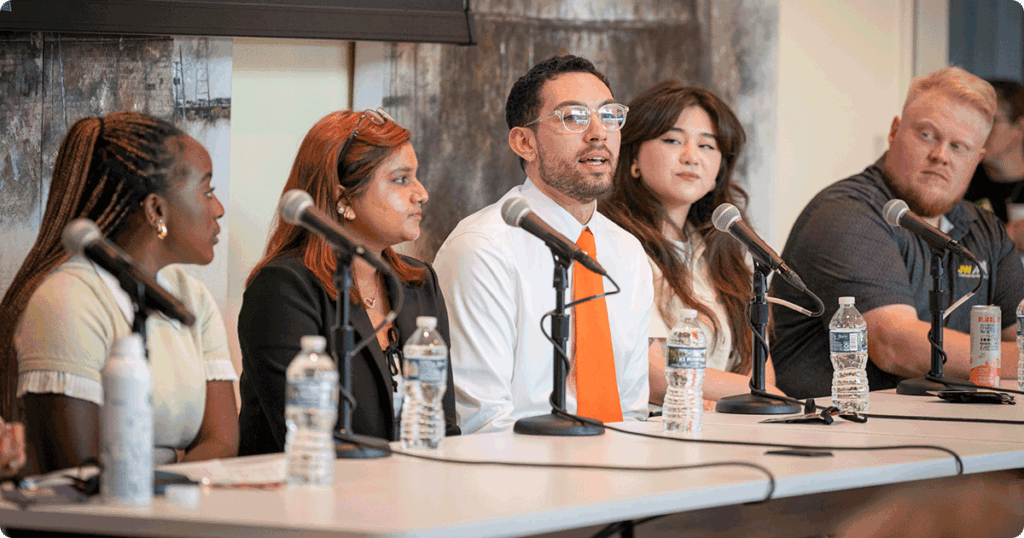
Panelists: Lorance Uwinaza, Sherlyn Alam, Chad Alexander Matha, McKenna Scherer, Wyatt Haas
In an economy rife with uncertainty, Wisconsin twentysomethings are carving out career paths by being resilient and adaptable, taking risks, and betting on themselves.
Five young professionals—Wyatt Haas, Chad Alexander Matha, Lorance Uwinaza, McKenna Scherer, and Sherlyn Alam—shared their experiences in the panel discussion “Starting Out: Can the Next Generation Build a Future in Wisconsin?” at the 2026 Wisconsin Economic Summit in Eau Claire.
Betting on himself
Haas, 29, co-owner of JW Home Improvement, grew up in a farming family in Osseo, started a construction business in his sophomore year at the University of Wisconsin-Eau Claire, and left college in the last semester of his senior year after landing a now-or-never contract in Wyoming.
“I’ve been moving my business slowly back into the Midwest and staying in Wisconsin. I think this is a good place to run a business,” said Haas, now based in New Richmond.
“The idea of the American dream, I think, has changed a lot,” Haas said. “I decided to start a business because I actually thought it was the less risky bet. Going into corporate America, I feel, is the riskier bet, especially as a young person. You’re not in charge of your future. You are at the whim of somebody you will never see who can, at any moment in time, decide that the budget doesn’t allow for you to have a job anymore. So, I view risk for me, in this current day and age—the less risky bet is to just bet on yourself.”
No straight path
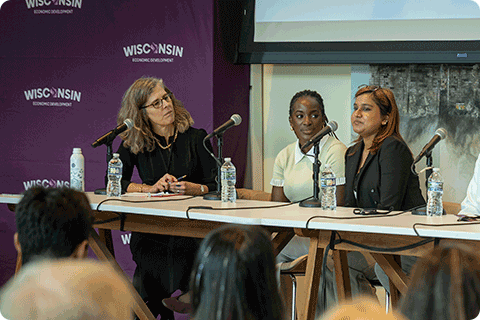
Moderator: Katherine Cramer, Panelists: Lorance Uwinaza, Sherlyn Alam
Alam, who turns 24 in mid-October, is a pharmaceutical manufacturing lab technician at MilliporeSigma in Madison. Born in Chicago and raised in Toronto before going to Malaysia for high school then getting a bachelor’s degree in neuroscience at UW-Eau Claire, Alam thought she had a solid career path after being hired as a clinical laboratory scientist at Exact Sciences.
“I loved it there,” said Alam, who was also supporting her mother and siblings when she was laid off due to company restructuring. “All those goals, they broke right in front of me, like that whole plan is destroyed.” Alam said. “I just felt so devastated.” But with the support of family and inspired by her late grandfather, who was an orphan in Bangladesh and became a noted chemist, Alam “got the courage and strength to apply and try again.”
“I never imagined myself going into the pharmaceutical industry,” said Alam, who acknowledges, “My path has never really been straight. I feel like I had a lot of twists and turns along with uncertainty. And I learned to adapt when I was younger from an early age.”
With all the uncertainty in today’s economy, Alam said, the main thing is “just being adaptable and trying to carve out a plan, which does not have to be perfect.”
Drawing on authenticity
Matha, 28, an artist and designer in Milwaukee, is pondering what Wisconsin “can give me in terms of an art career.” “It isn’t the easiest in the Midwest,” said Matha, a descendant of the Ho-Chunk Nation whose main media are sculpture, textiles, and leather works. “A lot of times, people are off to the coasts, off to New York City, off to Chicago or L.A.”
A graduate of the Milwaukee Institute of Art and Design, Matha received the 2026 Wisconsin Visual Art Achievement Award for Emerging Artist and recently had a first solo exhibit. But, Matha said, “What might look successful on paper to a broader audience isn’t always reflected in your finances.”
“Being an artist in 2026 you can’t just be that. You have to be a multihyphenate of things to really become successful and achieve what you want to, especially working independently and for yourself,” said Matha.
Noting that Wisconsin ranks 48th among the 50 states for arts funding, Matha said he sometimes wonders what keeps him here, “but my family’s here. I care about them. I care about standing up for Native voices, standing for queer voices. And I do think that is more necessary in states like Wisconsin … where there isn’t that same kind of representation.”
‘My people’ are here
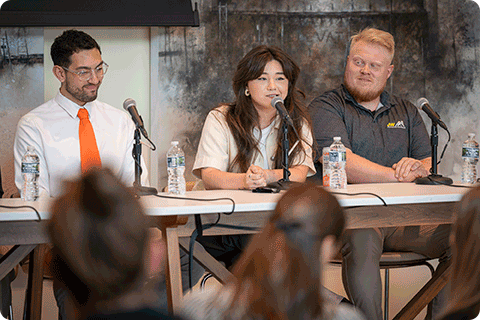
Panelists: Chad Alexander Matha, McKenna Scherer, Wyatt Haas
McKenna Scherer, 26, managing editor at Volume One in Eau Claire, grew up in the Chippewa Valley and went to the University of Minnesota, where she studied journalism, worked on the school newspaper, and “fell in love with telling real stories on campus.”
Scherer wasn’t planning to return to Wisconsin. But after a disheartening employment search—with no problem getting interviews and callbacks, only to come up short on experience—Scherer got an email from her now-boss with the subject line: “Do you want a job?”
“I moved back pretty abruptly,” said Scherer, who found “Eau Claire had changed so much.” “I fell back in love pretty fast with everything that had happened here,” Scherer said, and “there was just something about people around here I just really liked.”
“I found that there was a lot of economic opportunity here,” Scherer said. “And almost at times more importantly, like I really felt like I had my people around here, and that made me stay.”
To make it in today’s economy, McKenna said, “You have to be unkillable … you have to have agility and ability … you need to be able to pivot … because we’re all looking for jobs. We’re all looking for security.”
Making a difference
Uwinaza, 27, is director of business engagement and the Young Professionals Program at the Eau Claire Chamber of Commerce. Uwinaza’s family, refugees from Rwanda, came here when Uwinaza’s mother was pregnant with Uwinaza, who went to UW- Eau Claire and got a first job at the city’s Lismore Hotel.
“I learned how much this community loves each other” and “loves to participate” and “do things together, which kind of kept me here,” said Uwinaza, who feels “grateful” and “privileged to have so much opportunity and be around people that are making those decisions and changing things.”
“Knowing that you can make a difference,” is important to Uwinaza, who is doing that through her work mentoring young professionals who are “scared of the unknown.”
“Everyone thinks that someone else is OK … I’m like, ‘No, and I promise you everyone has some degree of fear,’” Uwinaza, said. “I think that transparency is such a big, key factor that I think can change the game for everybody.”
Legal Disclaimer:
EIN Presswire provides this news content "as is" without warranty of any kind. We do not accept any responsibility or liability for the accuracy, content, images, videos, licenses, completeness, legality, or reliability of the information contained in this article. If you have any complaints or copyright issues related to this article, kindly contact the author above.
